It was a miracle of sorts that NBC's series Hannibal made it to the end of its third season before being canceled. Ostensibly, it was a crime procedural and thriller focusing on a gifted FBI profiler's pursuit of a prolific and elusive serial killer, unknowingly accepting his help on a number of cases as well as becoming his friend. Beyond that, it was profoundly weird. A bizarre creature, the show crossed several genre lines without explicitly committing to any single one, demanded a level of audience participation that most broadcast shows dare not ask, and week after week, brought to the small screen an onslaught of increasingly lurid murder tableaus that pushed network limits.
Despite its oddness -- or perhaps because of it -- I find myself returning again and again to this short-lived series, replaying its highlights, and scouring Netflix for similar titles in hopes of prolonging its spell. Along the way, I've pitched it to many a friend but failed each time to articulate just what makes Hannibal such a deeply affecting and worthwhile watch. And here, finally, is my attempt to make sense of its appeal, even if only to myself, because I still get lost in its richness sometimes --
13 / CHIAROSCURO

Like many other screen tales that veer uncomfortably close to the macabre or monstrous, Hannibal plays with light and shadow, showing us how eerily different the same objects or people can look in the wrong (or rather, horrifically right) light. The production design team uses shadow to great effect particularly when framing Mads Mikkelsen's Hannibal Lecter for a shot: brows and cheekbones loom forward and eyes sink in, leaving the audience to face a floating skull in the dark. It's Caravaggio converging with the bony architecture of Kutná Hora, and the result is deliciously chilling.
12 / GENDER-CONSCIOUS CASTING

Developer and executive producer Bryan Fuller has called the original gender composition of Thomas Harris' Hannibal novels a "sausage party." The journalist Freddie Lounds and psychiatrist Alana Bloom are male in the source material (Freddy and Alan respectively), so Fuller and his writing team made the deliberate decision to swap some gender identities around and bring balance to the show. Also added: the bright and resourceful Beverly Katz (notably played by an Asian-American actress), as well as original character Bedelia du Maurier, a calculating figure who holds her own against Hannibal Lecter in a way no one else can match.
11 / OVER-THE-SHOULDER MEDIUM SHOTS


A wide range of characters are given over-the-shoulder medium shots by way of introduction to a scene, but none in more interesting ways than protagonist pair Hannibal Lecter and Will Graham. With Graham, these shots are an invitation to identify -- a visual parallel to the FBI profiler's empathy disorder as he kicks down doors, stands before crime scenes, and surveys the bloody landscapes before him with a heady mixture of horror and excitement. With Lecter, these shots disinvite identification. They distance us from the faceless, fastidious figure by calling into sharp relief that which we cannot see: his expression, his handiwork, his motives.
10 / ANGLES, SPACE, INTIMACY

Armed with a razor-sharp sense of space and dynamism, the Hannibal cinematographers frame their scenes like lines of poetry. Not a detail is out of place, and no space is wasted. It's masterful visual compression of movement and meaning: tilt and crop an actor's face at just the right angle, and we are left with a shot that has tension, direction, balance, and a fierce and almost voyeuristic intimacy -- all efficiently packaged together.

09 / ORIGINAL SCORE & SOUND MIXING

I once watched an episode of Hannibal with a musically-inclined friend who found the score profoundly off-putting. To be fair, if approaching the score with expectations of harmony and melody, it certainly would be jarring -- and that is, of course, wholly the point. Brian Reitzell's unconventional compositions for the series are abstract, utilizing a variety of uncomfortable sounds to elicit the kind of stomach-turning fear and anxiety that the characters themselves must live and struggle with. In the show's key moments, be prepared for the sounds of twisting, accordioned plastic pipe, metal clanging against metal, and the slow-dripping creep of something macabrely viscous.
08 / VISUAL SYMBOLISM

There is an entirely unselfconscious glee to just how symbolically heavy-handed Hannibal allows itself to become. It begins with the meaty, bloody color palette of the first two seasons and Hadean objects on Lecter's dining table, and it culminates in full moons, dragons, and crumbling precipices by the end of season three. (And when Lecter's face disappears into a projected image of Lucifer early in season three, you just know someone on set high-fived themselves for coming up with that.) But none of it is dull or even all that predictable: one can have a lot of fun zeroing in on symbolic references and finding the undercurrent of gothic humor beneath them. (Freddie Lounds' all-red, blood-slick, meat-like outfit in season one, anybody?)
07 / TOUCHING THE GROTESQUE

From episode 1.01 Apéritif: "Everyone has thought about killing someone, one way or another" -- but Hannibal dares to admit it. Dares more than admit, even. It embraces, with reverence and passion, a part of humanity that we like to tell ourselves is unspeakably ugly. And yet: here we see the ugliness elevated to art. This is our doorway into the mind of Will Graham, in which horror is bound up with beauty, and the difficulty of reconciling that perspective with desirable normalcy is -- for both viewer and Graham -- deeply unsettling. Hannibal wants us to feel that secret conflict, that oppressive anxiety and inwardly-turned fear and disgust of harboring a terrible appreciation and attraction that everything you know is telling you ought not to exist.
06 / HUGH DANCY'S WILL GRAHAM

I never know where to begin with Will Graham, and perhaps his on-screen boss Jack Crawford, director of the FBI Behavioral Analysis Unit, puts it best when he notes, "We can't define Will at all." It is a delight to see Graham at the heart of the series rather than the better-known Clarice Starling, since Graham's empathy disorder forces him to vividly relive the crimes of others, both shocking him and tempting him over to Lecter's side of the monstrous, beyond-human veil. Graham provides a wealth of material to interpret, as the answer to any question about him is both yes and no. It is hard to know where Graham stands, even harder to know what he is capable of, and even harder still to guess his next steps. Soft and tough by turns, vulnerable and aggressive, Graham is played as both pawn and mastermind, victim and destroyer, by a capable and nuanced Hugh Dancy. Dancy sparks with nervous energy in one scene and is glacial in the next -- he keeps us guessing as Will Graham should.
05 / "WE'RE JUST HAVING CONVERSATIONS"

Arguably, Hannibal's greatest asset is its script. Enormously efficient, clever and resourceful, it mines Harris' source novels for every usable detail -- not merely dialogue -- and cobbles together from them a rich and layered text of tense back-and-forths, philosophical development, and internal references. And arguably, the script was likely what nixed the show's chances of survival: a series that depends too heavily upon the slow build of careful, chess-like conversations between characters runs the risk of alienating casual viewers, reducing audience size as plot progresses. That said, I'm glad Fuller et al stuck to their guns rather than cave to the ratings game and maintained, for three seasons, their subtle and demanding character interactions.
04 / UNBRIDLED THEATRICALITY
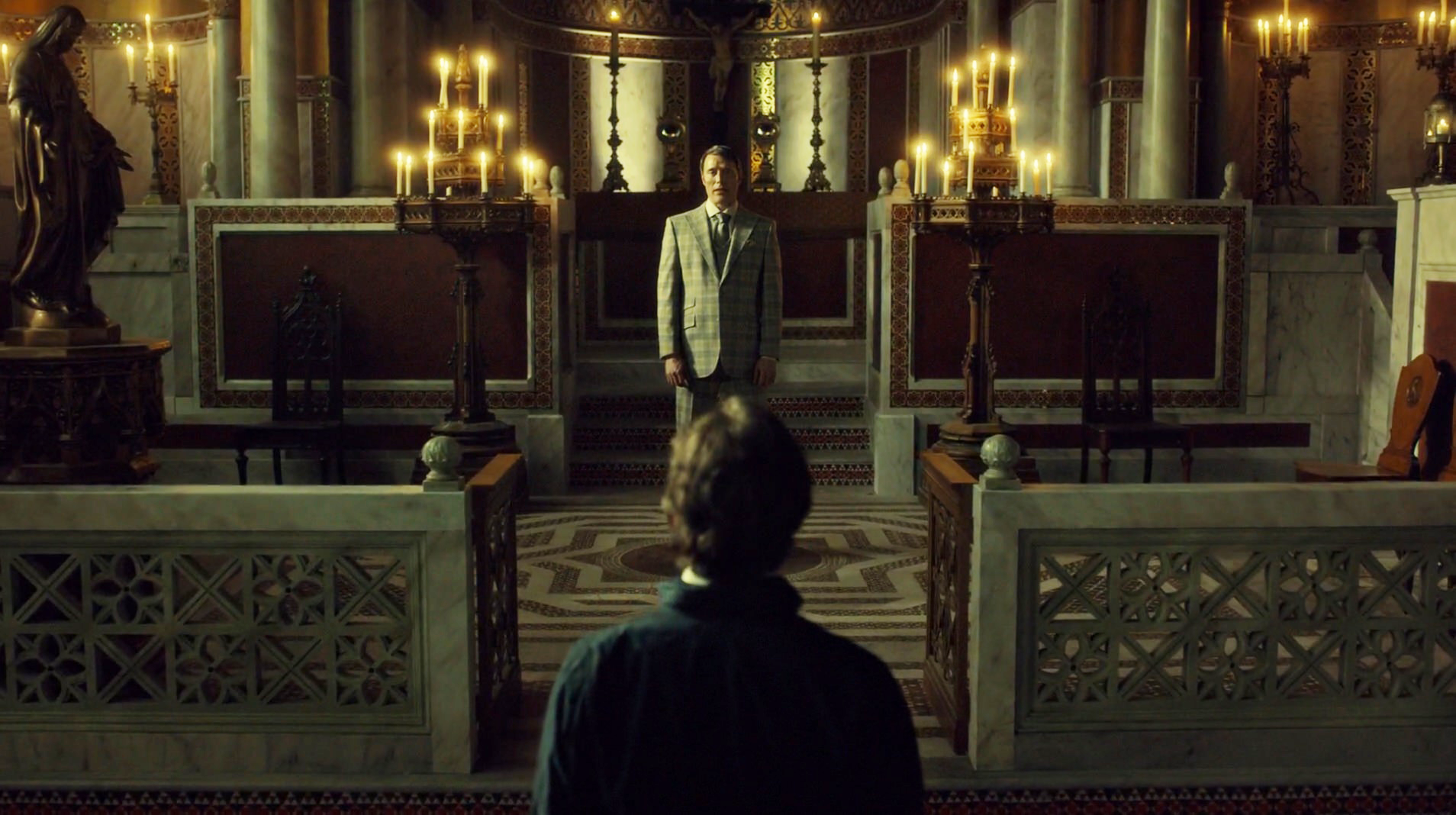
To say that Bryan Fuller and the production team have a flair for the dramatic would be a shameful understatement. Hannibal, visually and thematically, is out of control. It is operatic, overdone, and unapologetically so, pushing the limits of the ridiculous until the viewer is forced to abandon measures of normalcy entirely. Mozart's Lacrimosa -- a musical overreaction -- playing over a brief scene of Hannibal Lecter being stood up by Will Graham? Why not. A man sewing a living person into a dead horse as payback for his crimes? Fair game. Major characters lying in a pool of blood that quickly becomes a rushing sea, complete with small, lapping waves? Just a day in the life. Hyperbole is the norm in Hannibal, and through unrestrained hyperbole it forces us to see the agonizing beauty in its fevered world.
03 / THE PSYCHE & NIGHTMARE LANDSCAPES

Here the dissection really should be left to others cleverer than I am. But I'll take a stab at it (pun intended). Many fans of the series have taken to thinking of Hannibal as serving an id-like function both for its audience and even itself. Fever dream hallucination sequences, exaggerated staging of eerie landscapes, grisly murder tableaus, heightened-reality memory palace constructions -- all are traces of an aggressive base instinct that must be balanced by the super-ego and regulated by the ego for its owner to have a functioning psyche and mental life. Hannibal is in large part concerned with the war for control, balance, power, self-actualization, and self-knowledge in Will Graham's mind, where the violent id is increasingly free to run. The nightmarish landscape of the series reads like the unconscious gear-grinding of a troubled mind.
02 / "WE'RE CONJOINED"

Penultimately: the meat of the show. The electric, puzzling, layered dynamic between Hugh Dancy's Will Graham and Mads Mikkelsen's Hannibal Lecter needs to be seen to be believed. Predictably, the FBI profiler and secret serial killer are locked in a game of cat-and-mouse (or a game of chicken? or both?), but by the start of season two it is wholly unclear who is pursuing whom. They become co-dependent, "conjoined", and something in the gray discomfort zone between mortal enemies and lovers. Seducing and being seduced -- they are nearly indistinguishable, simultaneous processes when it comes to these two, who spark off each other with a potent mixture of hatred, aggression, intrigue, affection and desire that transforms and ignites everything around them (sometimes literally).

01 / LECTER AS SATAN

Danish actor Mads Mikkelsen (otherwise best known for his turn as the icy Le Chiffre in Casino Royale) had big shoes to fill when he took on one of pop culture's most iconic roles, and fill them he did. Mikkelsen's take on serial killer, psychiatrist, and cultured aesthete Hannibal Lecter is agile and elegant, markedly restrained, and frightening in his total control. He exudes a screen presence that lingers even after he steps out of view, a shadow cast over others' faces. "He's the devil. He is smoke," says a season one antagonist, hitting the nail on the head as to what makes Mikkelsen's rendition so striking: sub-textually, he is played as Lucifer, a being somewhat beyond the realm of human but living among people, generating chaos for chaos' sake and tempting those around him with -- rather than an apple -- the unspoken urges presented to them by their own psyches. Everywhere and nowhere at once. And even for all his devilry there is a charm to him: you want to believe him, want him to get away with things, want him to linger and whisper manipulation into patients' ears.

The Critics on Hannibal
"Hannibal is one of the wisest, strangest shows on TV about the potential and peril, thrill and terror of emotional vulnerability and engagement -- of being known by another, of consuming and being consumed by another. [...] The show is also about the fascination with evil and our romance with the genre in which it's most often explored, Gothic horror, and in a moment replete with cheap and shallow Gothicacka, Hannibal's unique brand of rich, reflective pulp is valuable." (Jeff Jensen, Entertainment Weekly)
"The show's greatest asset is its mastery of tone, a quality most shows don't have the time or inclination to get right. Hannibal's formal daring is never empty showmanship; it's always in service of making the whole series feel like an endless lucid nightmare." (Matt Zoller Seitz, Vulture)
"...an engrossing, psychologically dense show that is also visually stunning. [...] Will...is as complex as Hannibal himself...and one of the show's creative coups is its depiction of his inner life. Will has an almost supernatural ability to get in the heads of serial killers, and the show dramatizes this ability by presenting mental landscapes in which Will imagines himself committing the actual deeds. This technique, coupled with Dancy's superb acting, shows how Will's 'talent' is also a horrifying form of self-torture. [...] And what about Hannibal himself? I won't say that...Mikkelsen is better than Anthony Hopkins in the role. But he is subtler...Mikkelsen has rescued Lecter from the hamminess of...Hopkins' post-Silence performances... It also doesn't hurt that this version of Lecter is new and fresh: He's a practicing psychiatrist, a practicing cannibal, a prolific serial killer, and the most popular dinner party host in town. This is a Hannibal we've never seen before, and it's a treat." (Mark Peters, Slate)